Showing posts with label music and liturgy. Show all posts

Rebbe Nachman's Yahrzeit: AZAMRA

The Yahrzeit  of Rebbe Nachman of Breslov is the fourth day of the week of the festival of Sukkos (Chai Tishrei).

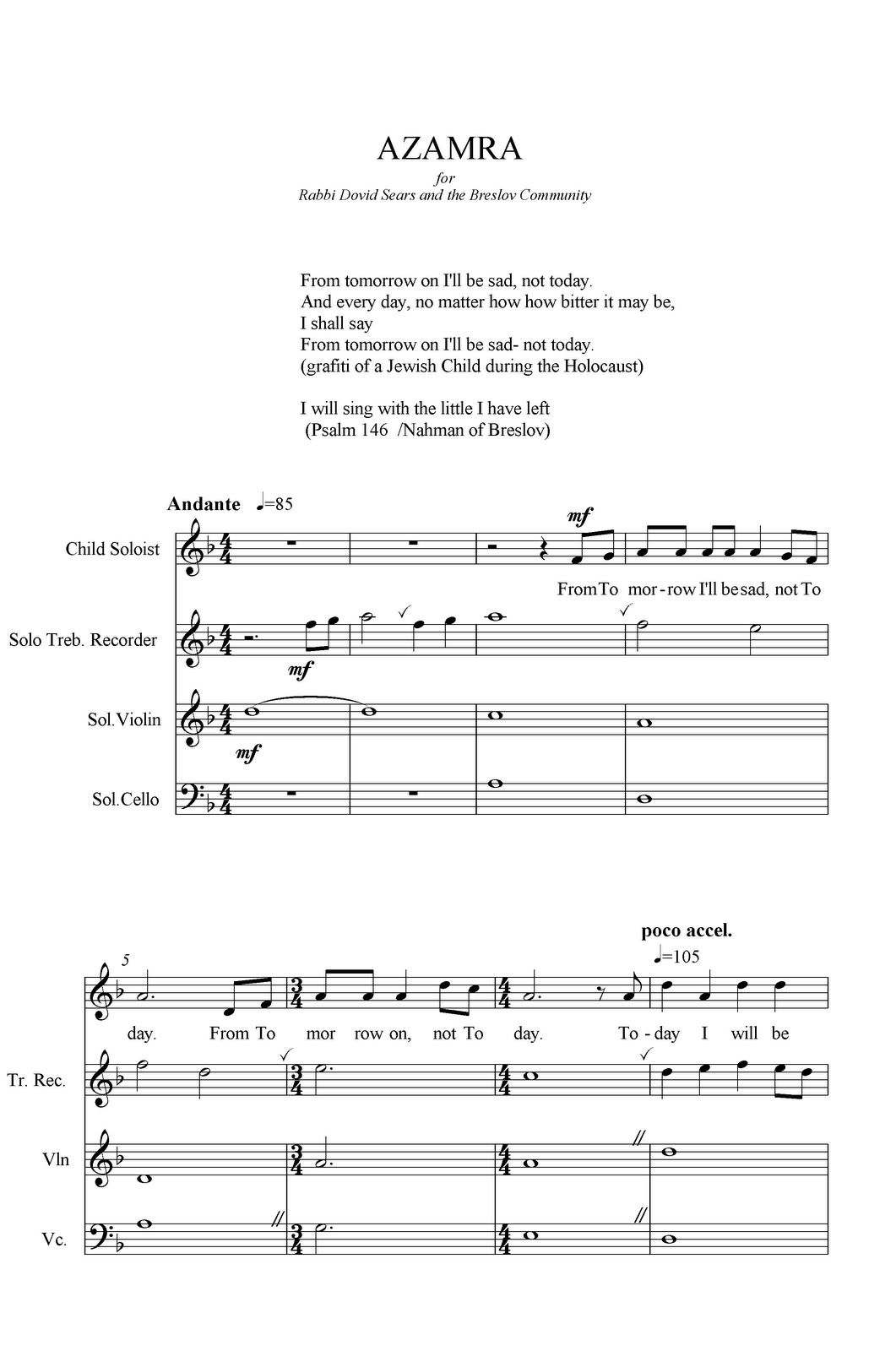
To celebrate this day, and in honour of Rebbe Nachman (may the merits of the Tzadikim shield us) I am posting  the score of a short musical composition which I wrote many years ago for the Breslov community, together with a few thoughts relevant to the texts used.


_____

However successful we may be (or appear to be)-  there are always times when we fail to do what we aspire to do. We often fail to approach “perfection” let alone attain it.  We may also fail because we do not have the abilities or skills we wish we had. 

But failure and disability are not always what they seem and if we have done our very best in the spiritual life, it really is not just “second best”. 

In the contemplative life, our intention and our effort are more important than all else. Being able to see the potential of whatever we are blessed with (and making the best use of it) is the greatest gift we can be given.

One of the favourite expressions of Rabbi Nachman of Breslov was   “I will sing to G-d with the little I have left”.    It is actually a psalm text (Psalm 146:2).   You can read his interpretation of that text in Likutei Moharan 1:282. 


I am not qualified to make comment on his exposition there—  but I can tell you what the phrase meant to me at the turn of the millennium:  I had, just then, finally begun to realise that my encroaching deafness meant that I could no longer function as a performing  and teaching musician.

I had been a school music teacher for over twenty years and that realisation took some getting used to. It actually took me four years, but I am well over it now and see the whole development as Providential— for if it had not happened I might not have been quite so compelled to listen  to the Still, Small Voice in contemplative prayer. 

The song I needed to sing was an internal one. We all have such a song written in the notation of our genes--and each person has their own melody—though it can often take an entire  lifetime to discover it.

At that time, the shock of becoming deaf helped me to become  aware that the "little time I had left" was diminishing rapidly, and that I had been given a wake-up call to make good use of it.  

As an expression of this realisation in teshuvah,  I resurrected an old composition I had written setting the text of Azamra in conjunction with a poem written by "Motele", an eight year old Jewish child during the Holocaust.  Its message was one of unquenchable optimism and a determination to make the most of things:

"From tomorrow on I'll be sad, not today.Though stormy  winds may blow today,Tomorrow's sun may drive them all away. And every day,no matter how bitter, I will say:From tomorrow on I'll be sad, not today."

--------------------------

            Here then is the musical score:
- To see each page clearly you will need to click on each separate page in turn.
- Click on each page to open them in a new window.
- Click  again to  enlarge to full size..


(Notes: The musical reference to the klezmer song “Spieltshe mir a liedele” is deliberate.  The work has yet to be performed:- I am totally flexible with regard to instrumentation, but would always recommend that the melody is sung by a child and not an adult. Metronome marks are just guidelines and may be over-ridden.)


Azamra l’Elohai b’odi  
(I will sing to G-d with the little I have left)

At those times when we are examining our response to the Divine call to  contemplative prayer,  “The little we have left” may refer to the years of life we have but it may also refer to our “abilities” in prayer or to the amount of time in a day or week or month that we are able to devote to developing an intimate relationship with Hashem in hisbodedus and hisbonenus.

To overcome any lack of fervour in our lives of dedication we should dig deep to awaken and raise up even the smallest , dormant spark of devotion which might lie buried in the lower reaches of our soul. Such sparks can be roused and fanned into a blaze of  life if we are prepared to make the effort.

We can beat back laziness, anxiety, and ingratitude by declaring “Azamra!”--however short our prayer sessions, however rare our retreats in solitude, however wrapped up in our families, or jobs, or secular studies we may be--what matters most is not the quantity of our contemplative actions and practices, but the dedicated and contemplative quality of our lives themselves. G-d sees the heart.

V’taheir libeinu l’ovdecha be’emes.
O, purify our hearts that we may  truly serve You.


Nachman Davies
Oct 8 2017

Purim: Treasuring the Concealed


HaShem hides Himself in the beauty of Concealment.
His  Wisdom is hidden from all human analysis.
                                       Avraham Maimin (1522-1570)

The festival of Purim is a celebration of the hidden action of  G-d in our lives. It is  often pointed out that His Name is never mentioned in Megillas Ester, and yet the entire tale is a demonstration of the power of Hashgochoh Pratis (Divine Providence) in the lives of those who trust Him yet do their part with gratitude—and  even bravery. The name of the principal protagonist  “Ester” is itself related to the hebrew “hester” (hiddenness). Goodness hides in the midst of evil and what seems like “A” turns  out to be “B”. Expectations  are turned “v’ na hafoch Hu” (upside down) and outcomes are seen to be part of a Divine Plan—but  in retrospect.

The life  of a Jewish Contemplative is also a celebration of the concealment  of the Hidden One.

Contemplatives are seekers who are engaged in a continuous process of discovery and not an elite who have somehow "arrived". A Jewish contemplative is ever engaged on a journey towards G-d and yet, as a Jew, he or she realises that the journey can never end. How could it when it leads to the One who is eternally ever-present? Such infinity is not something we can ever grasp or possess.

 The Jewish Contemplative hopes to be granted an experience of the Eternal One but accepts that this experience can only ever be partially understood. It is an encounter with a deeply veiled awareness of a Presence whose actual Being is beyond our comprehension. Most Jewish mystics experience only the very merest hint of this veiled Presence, and yet the memory of that fleeting moment is often sufficient to inspire a whole lifetime of contemplative yearning for further contact.

Such a motivating experience is an experience of deveykus (cleaving and attachment to G-d). It is not a superior state of human perception and understanding achieved by any practice or method of our own devising and it cannot be taught. It is a form of moral and spiritual contemplative bonding which simply makes us useful to the Creator. Its purpose is to show us that we are in a relationship with One who requires our effort, our loving compliance, and our determination to be made more “in His image” as each day passes.

In a nutshell, when we cease to see ourselves or focus on our own needs, but look in G-d’s direction and hope to meet Him in some way, we will find ourselves looking back through His eyes. This is perhaps the closest we can come to “enlightenment” and experiencing it is a process which never ends.

If there is to be any enlightenment on a Jewish mystical path, it does not consist in arriving at an all-encompassing grasp of the Divine master-plan- rather it is something which is most usually encountered in moments of semi-prophetic or inspirational intuition which can then nourish our otherwise transient and changeable experience. As Jewish contemplatives, we are expected to draw nourishment from the deeply buried memory, the muffled echo, and the glimmering after-glow of Sinai as it presents itself to us in the ordinary but often synchronous events of each and every day. To see and hear the unbearable thunder of the Voice of Sinai in every moment was beyond us then and it is beyond us now. Our blessing is to be spoon fed digestible measures of spiritual manna and to hear the message of that Voice as a still small whisper, a barely distinguished hint, a kol d’mama dakah.

When we daven or meditate, when we spend time with our G-d in discursive hisbodedus or reflective hisbonenus, we do not do so because we want to achieve something for ourselves-we pray because we are commanded to and because we wish to take our observance of the commandments to   “cleave to G-d” and to “love Him with all our heart, soul, and strength” to their fullest and most authentically Jewish levels. Not as an act of philosophy, spirituality, or mysticism per se, but as an act of religious service.

The effectiveness of this realistic and humble approach to the spiritual and mystical journey has its root in the process known as bittul haYesh: There is no point in demanding that our thirst for total control over the wildness of existence be quenched at all costs.  Our desire for certitudes and a clear vision of a spiritual 'G-d-particle' is certain to miss the target as The Target is simply beyond our reach and skill. It is an approach which reminds Jews of their own place as the devoted servants of a commanding and loving G-d.  The concealment of G-d is not a barrier to be breached, nor is it a negative situation which we ought to try to “remedy”.  It is the Kevod of HaShem made partially accessible.  It is a gift to be treasured.

In Tehillim we read:

“Wonderfully concealed are your testimonies,
Therefore my soul has treasured them.”
Psalm 119: 129

The words of the Living G-d are pathways to walk on, shining lights to inspire us or guide our choices; flowing rivers to nourish our seminal hopes and growing thoughts; and they are a Tree of Life which is planted in heaven yet intended to bear fruit on this earth. In other words, they are a process not contained by tangible items or mental conceptualisation and the One who makes them has made them as ultimately beyond our full comprehension as His own Being is and always will be.

This in itself is a treasure, and being aware of it enables us to be both the beneficiaries and the transmitters of the Hidden  Light we are then freed to hold  in our embrace despite never being able to grasp it as a hoarded  possession.

One who treasures the concealed word of HaShem in the Torah haNistar in their prayer and meditation and who seeks to live the Torah haNigleh in their daily study and work knows that this Torah cannot ever be used as a spade to dig with, nor as a crown to be hoarded away for personal pleasure.

All  of a Jew’s relationship with HaShem is for the sake of the outflowing of the Divine into our world. The reward of a mitzvah is another mitzvah, and even the blessings which are granted specifically to Israel are ultimately for the sake of all nations and for the sake of all creation.  As the Berditchever Rebbe reminds us:

“When one nullifies oneself completely and attaches one’s thoughts to Nothingness, a new sustenance flows to all universes. This sustenance did not exist previously.”
Quoted in Aryeh Kaplan’s “Meditation and Kabbalah p.305

These words are most encouraging for those of us who make their prayers their main contribution to the tikkun (healing) of the world’s woes yet often wonder if their endeavours are of any use.  Jewish Contemplatives then, are both the beneficiaries and the transmitters of the Hidden Light. The transmission is most effectively brought about when we are as observant and as whole-hearted in yiddishkeit as we possibly can be.

That Psalm 119 verse I quoted (Wonderfully concealed are your testimonies, therefore my soul has treasured them) - tells us that G-d’s “decrees” for our life-history are not known to us, yet we ought to rejoice that our “fate” is in such good care. We make our own choices and face our trials, that is true, but He is our watchful and guiding shepherd at every moment.

The messages hidden in the “testimonies” of G-d are often very well hidden indeed. They are beneath the surface of the ordinary events in our lives. They are in the familiar texts of our prayer-books and bibles. They are in the often bewildering insights and intuitions which we receive in contemplative prayer. They are also in the insights of our prayerful study of Torah in meditation: Often, such insights are at first dimly perceived, but they can dazzle us when we suddenly “see” what we are being told/shown, each of us individually seeing something personally spoken to us in intimacy.

Our father Isaac goes out at dusk to meditate in the field.
At dusk, ordinary things are often bathed in a soft focus
And we can see their inner light more accurately.
At dusk ordinary things can sometimes fade into the half-gloom
And we turn inward to see our inner light in a more heightened way.

The growing darkness is sometimes our best friend and not an annoyance or an enemy.
It often leads to the place where we can see that our clouded perception of G-d is not just the adoption of a realistic approach-
The cloud of darkness prevents us making G-d in our own image.
It is actually closer to the Truth of G-d’s nature than any detailed theology ever could be.
The Divine which is concealed will always elude our attempt to grasp it.
But we can let G-d, the Hidden, grasp us
Through our loyalty as servants
And hold our hands as friends,
Thus, we can be held by the Hidden and know some of the power and beauty of our G-d.

When we experience an ecstatic sexual or sensual feeling
We reflexively close our eyes to improve our mind’s savouring of the physical event.
In contemplative prayer our eyes are metaphorically shut,
But we may discover that we actually “see” better in the dark.
We may not be able to see G-d’s plans for us
But being “kept in the dark” is not always a negative thing.

A contemplative is happy to know that the answer is not (necessarily) “42”.
A contemplative is not looking for answers but is allowing G-d to lead—to wherever.

Being in a Divine/human relationship in which we are informed on a “strictly need to know” basis does not  indicate that we are being kept in a subservient state of ignorance. As contemplatives, we are enlightened by a form of loving revelation whose brilliance we could never bear without the embrace of the Cloud of Unknowing.

This is the treasure of the Hidden One.
Our task is to make sure we don’t hoard it for ourselves,
But allow G-d to make us into transparent conductors of its Light.

Nachman Davies
Ta'anit Ester 5777
March 9 2017

Azamra: Doing Our Best - (Nov 2010)

However successful we may be (or appear to be)-  there are always times when we fail to do what we aspire to do. We often fail to approach “perfection” let alone attain it. We may also fail because we do not have the abilities or skills we wish we had. But failure and disability are not always what they seem and if we have done our very best in the spiritual life, it really is not just “second best”. In the contemplative life, our intention and our effort are more important than all else. Being able to see the potential of whatever we are blessed with (and making the best use of it) is the greatest gift we can be given.

One of the favourite expressions of Rabbi Nachman of Breslov was “I will sing to God with the little I have left”. It is actually a psalm text (Psalm146:2) You can read his interpretation of that text in Likutei Moharan 1:282 but I can tell you what the phrase meant to me at the turn of the millennium. Those who have visited this website before will be aware that I had been a Discalced Carmelite friar before my conversion to Judaism. I was very young when I entered the Carmelites and in many ways not ready to take on the yoke of a dedicated life. It came as a great surprise to me some thirty years later that I should be seeking to shoulder that yoke again.

I had, just then, finally begun to realise that my encroaching deafness was such that I could no longer realistically carry on being a musician. I had been a school music teacher for twenty years and that realisation took some getting used to. It actually took me four years, but I am well over it now and see the whole development as providential ... for if it had not happened I might not have re-discovered my vocation by deciding to live as a “DJC” (Dedicated Jewish Contemplative). The song I needed to sing was an internal one. We all have such a song written in the notation of our genes--and each person has their own melody--though it can take a lifetime to discover it.

During the process of return (teshuvah) which I have just described, and to express it ....I resurrected an old composition I had written setting the text of Azamra in conjunction with a poem written by a child during the holocaust. Its message was one of unquenchable optimism and a determination to make the most of things. It was originally part of a much longer work called "Adon Olam",but this particular song from that set of musical reflections  needed a little more work as I was not happy with the closing bars.  In the first version, the song ended wistfully, in this new 2009 version I added a much more "elevating" and affirmative end -section (beginning bar 45) in  the spirit of Rebbe Nachman of Breslov.... that seemed appropriate as I had revised it as a “thank you” present to Rabbi Dovid Sears, a Breslover Rabbi in Brooklyn, who has encouraged me greatly in my work as a contemplative. I am sharing it more widely here today. Here is the score:

(to see each page clearly you will need to click on each separate page in turn.
use your mouse's right-click to open pages in a new window)


(Notes: The musical reference to the klezmer song “Spieltshe mir a liedele” is deliberate.  The work has yet to be performed:- I am totally flexible with regard to instrumentation, but would always recommend that the melody is sung by a child and not an adult. Metronome marks are just guidelines and may be over-ridden.)


The “Azamra verse” popped into my head again while I was writing this week’s Hegyon ha-Lev (lectio divina) commentary on our Community’s private website.   In Malachi chapter 1 (Haftaras Toldos), we read of a scathing criticism of the Levites and Priests in the temple. Their dedicated service had become half-hearted and superficial.  In Malachi 1:13 the priestly acedia (religious boredom) had caused them to exclaim: “Hinei ma’t’laah” which I would translate as “Sheesh, this is a pain”.  All of us are capable of the same lack of gratitude for the contemplative calling and the same lackadaisical attitude in our prayers.


The Torah text of Parshas Toldos says:

“And he built an altar there and called on the Name of the Lord and pitched his tent there, and there Isaac’s servants dug him a well”

Each of those steps can be seen as a process in our contemplative horarium.

We build an altar when we prepare for the time of prayer by acts of tzedekah, by religious study, and even by the simple but intentional act of setting time aside on a daily or weekly basis for acts of worship and prayer.

We call on the Lord when we are engaged in the daily and Shabbat liturgy, when we are in our regular periods of hisbodedus or hisbonenus....the prayer of informal dialogue and the prayer of contemplative attention. Remembering the admonitions of the Malachi haftarah, we ought not to neglect such prayer if we are “not in the mood”. Instead we ought to remember that

“tov me’at tachanunim bekavana mei’harbei shelo bekavannah”
(better to say fewer words of prayer with proper focus than many words with no focus at all).

This phrase from Orach Chayim 1:4 is applicable to all times, even when we are so depressed and devoid of any joy that the most we can do is to make a brief but sincere apology our only prayer. God sees the heart.

We pitch our tent when we remember that the present moment and location is all we truly have. When we do not allow ourselves to be deceived that our “reward” or the “solution to our problems” is in the future. To be satisfied with what we have and see that our task is to make full use of it now and not tomorrow. In other words, “pitching our tent” is achieved by three things:  mindfulness of the present (faith), equanimity in the present (trust), and creativity in the present (love). Not tomorrow. Now.

If we do our best to practice those three things, we may well find that they have become, as it were, our “servants”. If we have prepared well, prayed with all our hearts, and settled ourselves with equanimity, these three “servants” will have dug the well for us. They will have reached the Living Waters and made it unnecessary for us to fret about ever reaching them by any additional exertions of our own.

In Malachi 2:5 we read:

“My covenant of life and peace was with him (Levi)
And I gave them both to him,
And also Awe and he feared me.”

Awe-
If we have honoured God in our preparation for prayer, and if we intend to offer our prayers in sincere gratitude as korbanot we will be undertaking our religious duties with Awe.

Life-
If we attempt to put our whole being into the act of prayer..especially when we feel no emotional or spiritual reward, we will have created Life ...which nine times out of ten will increase our feeling of zeal and dedication of its own accord.

Peace-
The sense of Peace which comes from having done one’s best is not pride in a job perfectly done. Our prayers may well have been acts which were full of distraction and selfish reverie and thus far from perfect. Yet if we have truly done our best, despite all that, then a true and realistic Peace is ours. The Peace of equanimity in His service.    A Jewish Contemplative is not scaling mystical heights or delving into spiritual depths in order to attain some sort of score or status. We don't do it to "make progress" or "attain a higher level". We do it simply to make ourselves available to God. We have nothing much to offer God anyway. Spiritual “success” lies in the intention and it is in this context that "doing our best is never second best”.

Our task is to fight the voice that says “sheesh, this is a pain!” when our life of dedicated prayer becomes boring, and replace that with quiet and unfussy gratitude, sincere effort, and the simple focus of true kavannah.
Azamra l’Elohai b’odi
(I will sing to God with the little I have left)
 
At those times when we are examining our response to the Divine call to be contemplatives it is not just for “full timers” like myself that these words speak. “The little we have left” may refer to the years of life we have but it may also refer to our “abilities” in prayer or to the amount of time in a day or week or month that we are able to devote to our “monastic” and contemplative side. To overcome any lack of fervour in our lives of dedication we should dig deep to awaken and raise up even the smallest , dormant spark of devotion which might lie buried in the lower reaches of our soul. It can be roused and fanned into a blaze of  life if we are prepared to make the effort.

We can beat back acedia, laziness, anxiety, and ingratitude by declaring “Azamra!”.....however short our prayer sessions, however rare our retreats in solitude, however wrapped up in our families, or jobs, or secular studies we may be.... what matters most is not the quantity of our contemplative actions and practices, but the dedicated and contemplative quality of our lives themselves. God sees the heart.

V’taheir libeinu l’ovdecha be’emes.
O,purify our hearts that we may  truly serve You.


N R Davies
26th October 2010
(Photo credit: Sorelle White 2010) 

.

Inner Sight - Aug 2010

“Re'eh”, the title of this week’s Torah portion means “Behold!” and many commentators use this as a starting point for reflection on either sight or perspective. I’ve been doing the same and in the process I remembered a song I once wrote for a school assembly on “The Senses”. It was called “Inner Sight” and though its simple lyrics and melody were geared to suit the Primary School children who sang it, its meanings were layered and intentionally relevant for the listening adults.

I looked up an old audio recording of it and today made a rather crude impromptu video to share it with you now, nearly twenty years after that little classroom recording was made.

Now that I am deaf it was hard for me to control this current audio recording, but I hope that it will be free from too much distortion. Visually, my PC skills are limited and do not do justice to Sorelle White’s remarkable photography... but again, I hope that the video will prove an enjoyable way for you to reflect on the message of this simple song.


The Zohar (one of the most respected texts of Jewish mysticism) frequently uses the phrase “Come and See” when it invites us to engage with a contemplative mystery. I think the “sight” we are invited to use here is cerebral but decidedly intuitive and not necessarily intellectual.

Sometimes we approach the Divine through our rational intellect  and academic study: The Talmudic or Philosophical approach can assist us in our reflections in both ethics and in spirituality.

At other times we access the world of the spirit through a different form of mental activity which involves intuition and possibly a form of revelation. Perhaps this is the kind of “mystical theology” we find in the poetry of such works as the Zohar. It is also the technique we employ when reflecting on scripture in Hegyon ha-Lev (Lectio Divina) where the contemplative is using the intuitive and receptive areas of the brain (or Lev) to allow some kind of access to the Torah “which is written on our hearts.”

This is what I had in mind when I wrote this children’s song in 1991.


May we value both the intellectual and the intuitive efforts of the human mind and use our inner sight to open our minds to whatever it may be that God is trying to say to each one of us individually or to show us through our inner vision right now in this present moment.


Here is the full text of the children’s song: Inner Light

1:Open your eyes and you will see
A world above full of mystery.
The sun so bright shining over a tree.
The stars of night glistening over the sea

Chorus:
See without looking and feel for the light.
The wonder is seeing what’s hidden from sight.


2:
Open your eyes and you will see
A world outside full of mystery
The way your friends reflect your smile
Their helpful hands leading all the while.

Chorus:
See without looking and feel for the light.
The wonder is seeing what’s hidden from sight.

3:
Open your eyes and you will see
A world inside full of mystery
Open the doors, begin to see
Imagine it all as you’d like it to be

Chorus:
See without looking and feel for the light.
The wonder is seeing what’s hidden from sight.


N R Davies
August 5 2010

Birkat Kohanim: New Music for the Priestly Blessing - (July 2009)

Judaism used to be a religion which had a temple cult and priestly sacrifices at its liturgical centre. The descendants of Aaron were its priests (kohanim) and the members of the tribe of Levi were its temple officials. Religious and observant (and usually Orthodox) Jews avidly hope that the  Temple liturgy and its full  priestly liturgy will one day be restored.

Rabbinical Judaism stresses the idea that, now that the temple does not exist, those sacrifices are replaced by prayers-- prayers which are offered not by hereditary priests but by all sections of the community.


When the Temple sacrifices and liturgy ceased, the animal sacrifices may be seen as having been replaced by prayer:- most often by liturgical worship ( songs, texts, and community recitations relating to the worship of the Levites) but also, I would suggest by silent contemplative prayer which I see as a kind of continuation of the silent rituals of the kohanim. It's worth mentioning that these rituals  include highly symbolic acts like tending a ner tamid (perpetual light) and offering bread or incense as well as the more usually remembered animal sacrifices. These are acts which can readily be “translated” into contemporary forms of spiritual activity by a lay contemplative.


“Let my prayer be as the incense offering before you,And the lifting up of my hands be as the evening offering.”Psalm 141:2


If the service of the temple has become the service of the heart. If the tribe of Levi’s function is to be perpetuated and not suspended or rendered obsolete:- it seems to me that the Dedicated Jewish Contemplative is a potential “Levite by extension”.

The tasks of such a contemplative are those expressed in Psalm 27:


“To dwell in the House of the Lord All the days of one’s life,
To behold the beauty of the Lord,
And to meditate in His Sanctuary.”

I have mentioned before that I was not the first to make a connection between the Levites and those wishing to lead dedicated lives of prayer: A beautiful expression of the idea is to be found in the writings of Moses ben Maimon (Maimonides) who wrote,


"Why did the tribe of Levi not merit an inheritance in the land of Israel and a share in the spoils of war together with its brothers?
Because it was set aside to worship God, to teach His direct ways and His righteous judgements to the public ...

Therefore, they were set aside from the ways of the world: they did not wage war like the rest of Israel and they did not inherit the land ... Rather, they are the army of the Lord, as it says ...

The tribe of Levi is not alone in this.
Rather, every single person of those who live in the world,
whose spirit has gratefully welled up,
and who has comprehended in his or her mind to be separated
and to stand before God,
to serve Him,
to worship Him,
and to know Him;
who has walked in the straight path that God has intended for her or him;
and who has shed from his or her neck the yoke of the many accountings that humans make of one another --

this person has become holy like the holy of holies, and God will be her or his portion and inheritance forever and ever. Such a person will have sufficient in this world, as did the priests and levites, as David, may he rest in peace, said, "The Lord is my portion of inheritance and my cup; You sustain my destiny" (Ps. 16:5)."
Mishne Torah in Hilkhot Shemitta ve-Yovel 13:12-13


In the traditional liturgy the prayer known as "Birkhat Kohanim" (The Priestly Blessing) is recited ritually  by descendents of the Temple Kohanim while the  congregation  gather before them to receive their solemn and highly charged blessing. The blessing is recited to a very ancient chant  which  remains largely consistent in  most synagogues. In the absence of Kohanim, the rabbi or cantor recites the  blessing without its  attendant physical gestures.  In both cases,the  congregation responds with affirmations of "amen" and  "may it be Your will".  The prayer is also recited by parents blessing their children on  the  eve of the Sabbath.

In 1992 I had a dream in which I heard  the text of that prayer sung to a different melody (viz. not the traditional chant).  I wrote the melody down immediately on awakening and reproduce it here now.  This week I arranged that same melody  in a simple  choir version but with slightly altered text in the choir part. (The cantor sings "may the L-rd bless you" the choir sings "may the L-rd bless us".......but there is  no reason why it could not be sung using the original text in the choir  version as well.)


RIGHT click on the graphics to see score full size

RIGHT click on the graphics to see score full size

Here is a version for BASS soloist which not only involves transposition,
but also a harmonic modulation between the sections
which may be more to the taste of some singers:
RIGHT click on the graphics to see score full size
.


.
These two videos can also be viewed on YouTube
HERE (solo version) and HERE(choir version).

Should you be interested, you can read about how I came to write the original melody in the first place,  and view some related "folk" calligraphy:      HERE


Kedushah: So Far and Yet So Near- (June 2009)

We have recently celebrated Shavuot, the annual festival of the First Fruits and of the Giving of the Torah at Sinai. I have been reflecting on the way that we place ourselves at Sinai every time we pray and have decided to publish an edited version of an article which I wrote for the sister website (Community of Jewish Contemplatives) as a post-festival reflection for a wider audience. It refers to our community as being an "Elijan" Community...but the tasks of Elijah are pertinent to all Jews and so I hope all readers will find what I had to say to be of some interest and relevance. It begins with a brief commentary on the prayer we call the "Kedushah": The Song of God's Otherness.
.Haftarah Yitro Isaiah 6:3

.

So Far and Yet So Near

.


The liturgical Kedushah which is developed from this text in Isaiah (and a related one in Ezekiel 3:12 ) is one of the prayers which is traditionally recited only when a minyan is present. If I had waited for such an occasion before saying it, I would only have recited it a handful of times in the last decade. My nearest Jewish synagogue is many hours away on a bus and (to my knowledge) there are no Jews living in my town or anywhere nearby.

Typically, in such a situation I make an exception for myself and rightly or wrongly, I “sing” the Kedushah every Shabbos during the Amidah. For years (for minyan purposes) I have regarded myself as present in spirit with the Knesset Yisrael of Sinai and since last September, specifically bound in prayer with the other members of the online Community of Jewish Contemplatives.

I think most people would agree that there is something very special about the recitation of the Kedushah during communal liturgy (whether it be physically communal or spiritually communal). Everyone will have their own favourite moments in liturgy, some of which will regularly serve to keep us on our toes, as it were. There are three points in my own Shabbos liturgy which always seem especially illuminated. Two of them are in the Amidah and one in the Sh’ma. All three are more or less guaranteed to send a shiver down my spine.

In the Amidah, the first “illuminated moment” is in the Avot blessing when we say “ El Elyon”. My own practice is to leave large pauses between the phrases of the first paragraph of the Amidah and as I say the words “El Elyon” (God Above all, beyond all knowledge, beyond anything we can fathom, beyond any actual or imaginary world we might ever travel to) I have always left a longer pause than usual. In that pause I attempt to feel a little something of the immense distance between God and ourselves. It is, for me, a moment’s celebration of God’s transcendence, not as something chilling and off-putting, but as something full of awe and wonder. We seldom address God by this one of His Names and that makes the moment doubly special, a moment to be savoured.

The second “illuminated moment” in my Amidah is the Kedushah itself.

When I recite the Kedushah I consciously prepare myself to stand with the celestial beings who are praying along with me, but as I haven’t the faintest idea what they might truly be, (despite their colourful and exciting categorization into Chayot, Serafim, Ofanim and so on) that too produces a sense of being lost in a world beyond my comprehension and certainly beyond my grasp. Yet I always feel particularly “close to” or “linked to” that other world during it. The same will be true for the majority of spiritually minded Jews when they recite the Kedushah. This is not surprising as, in whatever language it is declaimed, it is one of the most numinous prayers in all liturgies. The creatures of the Celestial world (Elyonim) and the People of the Earthly world (Techtonim) rarely meet so explicitly in the liturgy.

The Elyonim are variously our guardians, our supporters, and our witnesses as we stand on that point at the end of our world during the Amidah. Some say that the two nods we give to the left and the right as we take three steps out of the Presence during the Oseh Shalom are an acknowledgement of that angelic collaboration in our worship. Being open to the idea that there is more to the Physical Cosmos than we know develops our humility and gives us a realistic perspective on our own place in Creation. Acknowledging the highly possible existence of other life-forms and different universes of prayer and praise co-existing with our own can similarly become steps towards developing an awareness of the Utter Otherness of their Creator and Sustainer .

The third “illuminated moment” is from an earlier point in the liturgy, before the Amidah, and it begins “Ani ADONAI” (I am ADONAI, The One who is). It is the last line of the Sh’ma. When we recite or chant this line, we speak one of God’s most personal declarations of immanence, yet it too serves to remind us that the One who is speaking is so Other that to be in His Presence so intimately can be almost unbearable. Reciting this last line with special focus, slowly and gently, listening to every sound and silent pause between its words and phrases can be one of the most intimate moments of communication with the “I” of our God in all the Jewish Liturgy.

The strange thing (for me) about all three of these moments is that they contain the most highly explicit feelings of awe in God’s Presence with the vaguest yet most tangible feelings of being somehow close to Him. Even when feelings are blunt, even at times when our faith, or trust, or perseverance are at their lowest ebb: these three passages still manage to keep us in mind of the enormity of what we do when we stand before Him.

The Kedushah is a celebration of this dual perception of God as both Transcendent and Immanent.

The first section (Kadosh, Kadosh, Kadosh)
declares “Other, Other, Totally Other, is He.”

The LORD of celestial Armies (ADONAI Tzevaot), He dwells in worlds beyond our comprehension and the Creatures who surround Him there in worship are as Aliens to us.

The second section (melo kol ha aretz kevodo) declares that He is present in all the atoms of all the worlds we know or ever could know. That He fills the space and time between those atoms, between our intuitions and thoughts, between our thoughts and our words, and between our experiences and our understandings. Inescapable. Inside each individual, as totally as He was in the Holy of Holies.

Being alone when I sing the Kedushah, for the last fifteen years I have always made it my practice to make up a totally new tune every time I sing the prayer. For the “Kadosh” line itself I have frequently spun off into a choking arabesque which was anything but musical sounding.

It’s my way of joining in the rushing around and wildness that Isaiah observed in the angelic choirs. I have yet to attain a satisfactory level of kavanah during the Kedushah, that is obvious! This failure to “seize the prey” musically is not a surprise to me. Indeed it may be one of the messages of the exercise. The attempt to describe God, the attempt to praise Him always fails…but exerting ourselves to the limit in the attempt is the best we can offer.


On a handful of occasions I have intended to sing and found that not a single audible sound would come out of my mouth….just the body forcibly making the movements which ought to produce the words. Strangely on those occasions I felt as though my song was closer to the one being sung around me/above…. I think there is a profound message there for me and for you. But I’m not going to try to write about it just now!


.

So far, I’ve been jotting down a few thoughts on the text and its use in a contemplative liturgy. But for us - contemplative prayer is our principal work, and so I really ought to say something now about the implications of the Kedushah on that.

The Kedushah text highlights the Transcendent and the Immanent. It has occurred to me that the text thus sheds its light on what I chose to call the M’arat Ha-Lev. This will take some explaining, but I would like to try:

The visions of Isaiah and Ezekiel have provided Jewish sages, mystics, and scholars with profound material for philosophy, theology, and countless methods of contemplative prayer. They have inspired esoteric mystical associations and entire schools of Jewish mysticism. But there is nothing in the visions of Isaiah or Ezekiel which surpasses the experience of every Jew present at Sinai. (Parshah Yitro, Exodus 19:9)

At Sinai we all saw the Voice of God as He laid Torah on our hearts. Some of it was heard but has not been verbalised. Some of it was seen but has not risen into our consciousness. All of us heard it in our own way and each of us is commanded to write our own torah as a result of what we heard. We are all invited to listen to that Voice. All of us.

Sinai, as I will never cease repeating, is not just something in the past: It is happening now in the Ever-present. What we need to do is find our individual place at Sinai again. Our spot at the foot of Sinai. Each of us has our own place and that place is the M’arat Ha-Lev , the Cave of the Heart .

There are tribes laid out at the foot at Sinai, and each tribe has its own charism. Though each one of us has a unique individual perspective, each of those tribes represents a shared path. A distinct group "way of doing things" within the People of Israel.


There are those who go down in the Chariot and there are those who are engaged in the Work of Creation. There are those who climb Sefirotic Trees and those who manipulate the Holy Letters. But the way of the M’arat Ha Lev is a simple path for simpler people.


There is one process to arrive there: Stand still.
There is one activity to perform: Listen.


It is the way of Elijah. Not the way of Elijah the zealot. The way of Elijah at the threshold of the cave: the place where the worlds meet.

In Kuntres M’arat Ha Lev I was using a sort of code. I was aware that the place at the end of the “unrolling carpet” on which we stand in prayer during a Contemplative "Standing" was a point in time and space and yet beyond them.

Several times I have described that point as the “intersection of the worlds”. In using that phrase I was referring to three types of intersection:


  • A place (physical time and space) where an individual human and God can “meet”;


  • A place (eternal moment) inside God and inside each individual where all spiritual meetings occur;


  • A place (expandable moment) in contemplative prayer where we turn away from looking inside ourselves to look through God’s eyes at other people.


The first two are perceived-experienced-engaged with during the Standing itself and the third is an event which can occur within it but can also “spill out” into the ordinary events and perceptions of our lives when we are not engaged in focused prayer. The third can, and often does, involve an imperative call to action.


I tried to express these ideas in stages by reference to Elijah’s Cave both in the kuntres itself and in the article on this website called “In the Cave of Elijah”. You will know from that article that my reading of I Kings:19 is that Elijah was not being scolded for retreating into a cave and ordered into active service- but that he was being scolded for not developing his contemplative service and the command to leave the cave was merely a command to appoint a successor.

I believe that the work of Elijah was unfinished. I believe that we are here to continue it. That is why I wrote Elijah’s name at the head of our Community members list. He was there already.


The essence of the Elijan experience of God (as I see it) is that we approach God (liturgically and metaphorically) in three steps: we pass through earthquake, wind, and fire (distractions, self-centredness, anxiety) and then, standing at the intersection between our world and His (the mouth of the cave), we focus with awe on His transcendence (with mantle over our face), then, and only then, we become open to hearing His Voice. (His immanence).


When we are standing at that still point, our personal place at Sinai, our Cave of the Heart, the part of God where we can see the sound of the speaking silence, we are not hoping for the visions of an Isaiah or the experiences of an Ezekiel. We are the sons and daughters of Elijah the childless and all we want is to be useful to God.

But like Isaiah, we are standing there to say “hineini” and with God’s help we may feel God respond “I am here too”, or perhaps “Good, Now do this…”.

.


In this graphic, the “point” of the M’arat Ha-Lev is at the threshold of the arch. It is a point of focus in the distance (the transcendent) and simultaneously it is a point of focus inside us (the immanent) represented by the starlight inside the star of David.

The angelic Elyonim are guardians, witnesses, silent worshipers. They are symbols of the event taking place, marking the point of intersection.

They are the keruvim of the ark, Lights who are “called” Shamor and Zachor.

They are silent.

Maybe that’s because they are listening and the Talmud says that the angels on high cannot “sing” the kedushah till we have “sung” it below.

Or maybe it’s because on the Elijan path, the contemplative is really only interested in hearing one thing, something which is heard only when all other sounds are silenced…..the still small voice….heard so deep inside our souls that its thunderous whisper can drown out any storm or shofar blast.


(This article was originally published on the Community of Jewish Contemplatives Website on Feb 12 2009 as a commentary on the Haftarah for Yitro.)

.